
Radcliffe
New York City Real Estate: Five Boroughs, Five Distinct Markets
July–September 2026 · November 11, 2026
Q3 2026 Market Report | Prices, Housing Supply & Buying Power
New York City real estate is often discussed as though it operates as a single market. In reality, the city's five boroughs represent different housing environments, ownership structures, and economic considerations.
Manhattan, Brooklyn, Queens, the Bronx, and Staten Island share the same broader economic environment, but the factors influencing residential real estate can vary considerably from one borough to another.
The composition of available housing, the cost of ownership, the amount of inventory, and the financing available to prospective buyers all influence how individual markets behave.
Understanding these differences is important when evaluating property values, assessing affordability, or deciding when and where to buy or sell.
In this edition of Radcliffe Real Estate Economics, we examine the forces influencing New York City's residential market, the relationship between financing costs and purchasing power, and why borough-level analysis provides a more meaningful understanding of local real estate.
The Bigger Picture: Understanding New York City's Housing Market
New York City's residential market is influenced by several interconnected factors.
The first is housing supply. The number and type of properties available determine the choices buyers have and the competitive environment sellers face.
The second is purchasing power. Mortgage rates, household income, down payments, and ongoing ownership expenses influence how much buyers can reasonably afford.
The third is demand. Employment, household formation, population movement, and broader economic confidence all contribute to the number of people seeking to purchase property.
These forces do not affect every segment of the market equally.
A change in mortgage rates may influence a buyer considering a condominium differently from an investor evaluating a multifamily property. Likewise, an increase in available inventory may create meaningful opportunities in one neighborhood without substantially changing conditions elsewhere.
This is why looking beyond citywide averages is essential.
01 — Manhattan: The Economics of High-Value Residential Property
Manhattan occupies a distinctive position within New York City's residential market.
Its housing inventory includes luxury condominiums, cooperative apartments, converted lofts, and a range of other residential properties. Differences in location, building amenities, ownership structure, and property condition can produce substantial variations in pricing.
For buyers, the financial considerations extend beyond the purchase price.
Condominium owners typically have common charges and property taxes, while cooperative owners generally pay monthly maintenance that incorporates building expenses and property taxes. Financing requirements and approval processes can also differ.
These distinctions influence the total cost of ownership and should be considered before comparing properties.
What influences Manhattan's market?
Building economics
Operating expenses, maintenance requirements, reserve funds, and capital improvements can affect the financial position of individual buildings.
Financing
Higher-priced properties may require financing outside conventional conforming loan limits. Mortgage terms, down payment requirements, and lender underwriting therefore deserve particular attention.
International and domestic demand
Manhattan attracts buyers from different geographic markets. Currency movements, international economic conditions, and domestic investment decisions can influence demand for certain property segments.
What buyers and sellers should consider
Buyers should evaluate the financial condition of a building alongside the apartment itself. Sellers should understand how their property compares with competing residences in the same building and surrounding market.
The broader Manhattan market provides context, but the financial characteristics of an individual property can be just as important as its location.
02 — Brooklyn: Housing Diversity and Neighborhood Economics
Brooklyn contains a broad range of residential property types, including brownstones, townhouses, condominium developments, cooperative buildings, and multifamily properties.
This diversity makes boroughwide comparisons particularly difficult.
The economics of purchasing a townhouse in a neighborhood dominated by traditional residential buildings are different from those associated with purchasing a condominium in a larger development.
Property taxes, renovation costs, building maintenance, and financing arrangements can all influence the overall investment.
What influences Brooklyn's market?
Housing characteristics
The condition, age, and configuration of residential properties can have a substantial influence on their marketability and ownership costs.
Neighborhood demand
Access to transportation, employment centers, retail, parks, restaurants, and other amenities can influence buyer preferences and residential demand.
Renovation and ownership costs
Older properties may require capital improvements that are not immediately reflected in the purchase price. Buyers should evaluate the potential cost of maintaining and improving a property before making a decision.
What buyers and sellers should consider
Buyers should compare properties with similar characteristics rather than relying on boroughwide median prices.
Sellers should pay particular attention to the availability of competing properties and the condition and presentation of their homes.
Brooklyn's market is best understood through its individual neighborhoods and housing categories.
03 — Queens: Affordability, Property Types and Transportation
Queens offers a varied residential landscape, including detached homes, multifamily properties, condominiums, and cooperative apartments.
Its geographic size and housing diversity create distinct residential markets within the borough.
Transportation is an important consideration. Access to subway lines, commuter rail, employment centers, and major transportation corridors can influence the attractiveness of individual neighborhoods.
The financial comparison between a condominium in Long Island City, a detached home in Bayside, and a multifamily property in another part of Queens involves very different considerations.
What influences Queens' market?
Transportation and accessibility
Commuting options and proximity to employment centers can influence residential preferences and demand.
Property ownership
Single-family homes, condominiums, co-ops, and multifamily properties have different financial and operational requirements.
Total ownership expenses
Property taxes, insurance, maintenance, and financing costs should be evaluated alongside the initial purchase price.
What buyers and sellers should consider
For buyers, Queens offers an opportunity to evaluate different housing configurations and ownership structures within one borough.
For sellers, understanding the immediate neighborhood market and the characteristics of competing properties is essential.
The purchase price is only one part of the affordability equation.
04 — The Bronx: Residential Value and the Cost of Ownership
The Bronx has a residential market that includes single-family homes, multifamily buildings, cooperative apartments, and condominiums.
The economics of these properties vary depending on their location, condition, ownership structure, and potential operating expenses.
Multifamily properties introduce additional considerations, including rental income, maintenance, operating expenses, vacancy, and applicable housing regulations.
For owner-occupants, the relationship between purchase price and ongoing ownership costs remains central to affordability.
What influences the Bronx market?
Property condition
The age and condition of a property can influence maintenance requirements and the amount of capital investment needed after purchase.
Multifamily ownership
Buyers evaluating multifamily properties need to understand existing leases, operating costs, legal obligations, and the financial performance of the building.
Financing and affordability
The availability and terms of financing can influence which properties are accessible to different buyers.
What buyers and sellers should consider
A lower purchase price does not automatically translate into a lower total cost of ownership.
Buyers should examine property condition, taxes, insurance, maintenance, and financing requirements.
Sellers should understand the specific market for their property type rather than relying on broader borough comparisons.
05 — Staten Island: Residential Ownership and Long-Term Costs
Staten Island has a residential profile that includes detached homes, townhouses, condominiums, cooperative apartments, and multifamily properties.
For many buyers, the evaluation of a property extends beyond the purchase price to the overall cost of maintaining a home.
Property taxes, insurance, utilities, maintenance, transportation, and the condition of the property all contribute to the financial commitment.
What influences Staten Island's market?
Property characteristics
The size, age, condition, and configuration of residential properties influence both purchase considerations and ongoing expenses.
Transportation
Travel requirements and access to transportation can influence the practicality of a property for different households.
Ownership expenses
Buyers should account for property taxes, insurance, utilities, and maintenance when evaluating affordability.
What buyers and sellers should consider
For buyers, understanding the full cost of ownership is particularly important when comparing properties with different sizes and maintenance requirements.
For sellers, the condition and presentation of a home, along with comparable transactions in the immediate market, are important considerations.
06 — Mortgage Rates: The Cost of Financing a Home
The purchase price of a property does not tell the entire affordability story.
For buyers who finance a purchase, mortgage rates influence the monthly cost of borrowing and the total interest paid over the life of a loan.
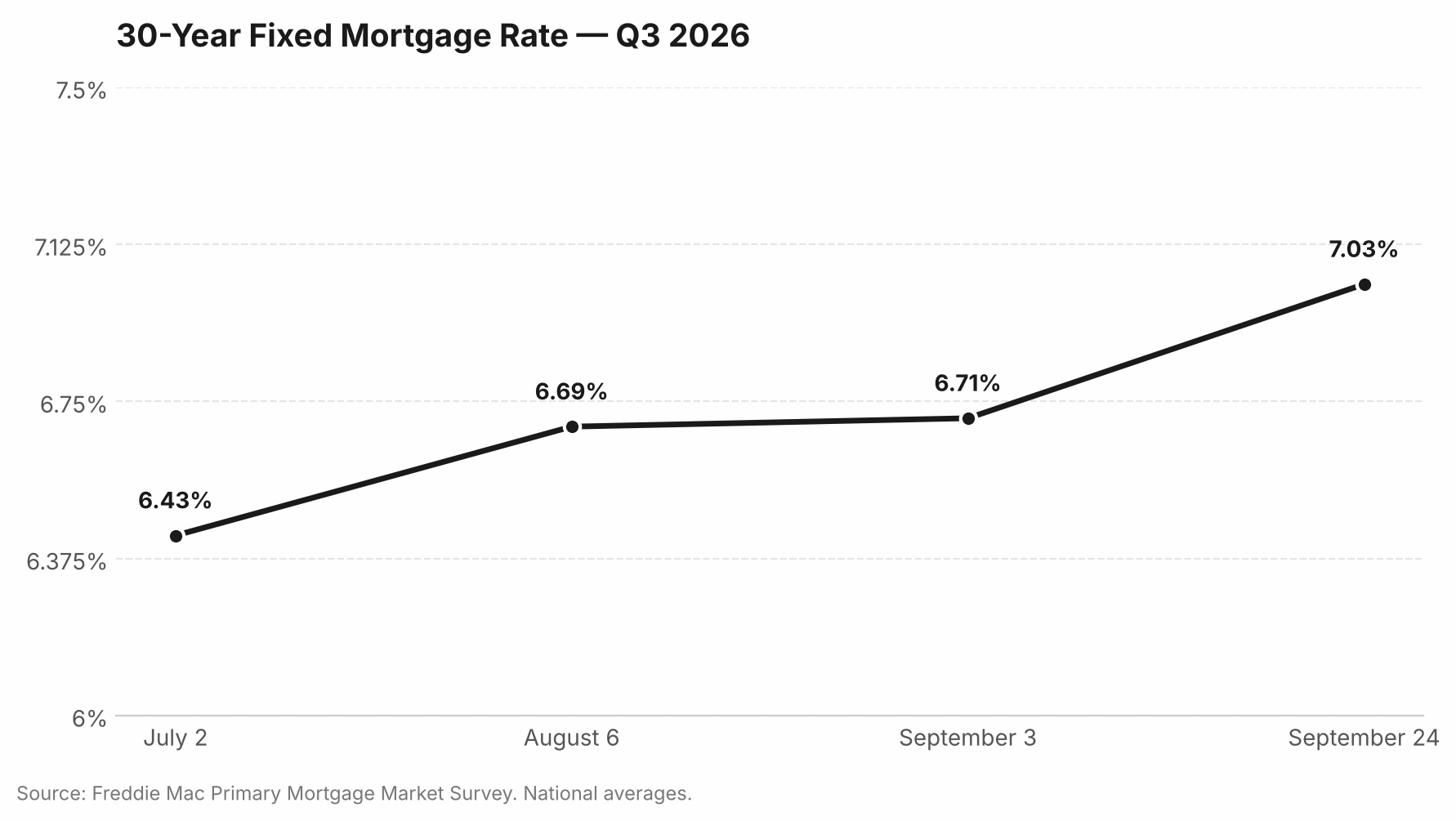
During the third quarter of 2026, the national average 30-year fixed mortgage rate increased from 6.43% on July 2 to 7.03% on September 24, according to Freddie Mac's Primary Mortgage Market Survey.
Although these are national averages rather than New York-specific mortgage quotes, they provide a useful reference for understanding changes in financing conditions.
What a change in interest rates means
Consider a hypothetical $600,000 mortgage with a 30-year repayment term.
At an interest rate of 6.43%, the monthly principal and interest payment would be approximately $3,765.
At 7.03%, the same loan would require approximately $4,004 per month.
That represents an increase of approximately $239 per month, or $2,869 annually.
The loan amount and repayment term remain unchanged in this illustration. Only the interest rate changes.
The example demonstrates why financing conditions deserve as much attention as changes in property prices.
The mortgage rate is not the entire borrowing cost
A mortgage payment is only one component of a homeowner's monthly financial obligations.
Buyers should also account for:
- Property taxes
- Homeowners insurance
- Mortgage insurance, where applicable
- Condominium common charges or cooperative maintenance
- Utilities and maintenance
- Potential assessments and capital improvements
For higher-value New York City purchases, buyers should also consider whether conventional conforming financing or jumbo financing applies. Freddie Mac's national survey is primarily a conventional conforming mortgage benchmark and should not be treated as a quote for every NYC purchase.
07 — Treasury Yields and the Mortgage Market
Mortgage rates are influenced by broader financial markets, including movements in longer-term Treasury yields.
The 10-year Treasury yield is frequently used as a reference point when discussing longer-term borrowing costs.
However, mortgage rates do not move in direct proportion to Treasury yields.
Mortgage-backed securities, investor demand, inflation expectations, lender pricing, and the spread between mortgage rates and Treasury yields also contribute to financing conditions.
This distinction matters because a decline in Treasury yields does not guarantee an equivalent decline in mortgage rates.
For buyers, following interest-rate movements can provide useful context, but purchasing decisions should be based on actual financing terms and personal financial circumstances.
08 — Housing Supply: Why Inventory Matters
Available housing inventory is one of the most important indicators of market conditions.
When more properties are available, buyers may have additional opportunities to compare prices, locations, property conditions, and ownership costs.
When available inventory is limited relative to demand, competition for desirable properties may become more pronounced.
However, inventory should never be interpreted as a single citywide number without considering property type and location.
A rise in available condominium listings in Manhattan, for example, does not necessarily improve the selection of single-family homes in Queens or Staten Island.
Three indicators worth following
Active listings
The number of properties currently being offered for sale provides a snapshot of available supply.
New listings
The number of properties entering the market helps indicate how quickly sellers are bringing additional inventory into the market.
Months of supply
This measure estimates how long current inventory would take to sell at the prevailing pace of sales, assuming no additional listings enter the market.
Together, these indicators provide a more useful picture of market conditions than listing counts alone.
09 — What the Data Means for Buyers and Sellers
Understanding the relationship between property prices, available supply, and financing costs is essential to evaluating the NYC housing market.
For buyers
The right purchasing decision begins with an understanding of total affordability.
A property that appears attractive based on its asking price may carry additional expenses that materially affect the monthly cost of ownership.
Buyers should consider:
- The purchase price relative to comparable closed sales.
- The amount of available inventory in the immediate market.
- Mortgage rates and financing requirements.
- Property taxes and ongoing ownership expenses.
- The physical and financial condition of the building.
- Their expected ownership period and long-term priorities.
For sellers
The right selling strategy begins with understanding the competition.
A property's asking price should be evaluated in relation to comparable closed transactions, competing listings, property condition, and the characteristics of the immediate neighborhood.
Sellers should consider:
- Recent comparable sales.
- The number and quality of competing properties.
- Current buyer financing conditions.
- Property presentation and condition.
- The relationship between asking prices and actual closing prices.
A citywide market trend can provide context, but it cannot determine the appropriate price for an individual property.
Looking Ahead: Understanding the Market Beyond the Headlines
New York City's housing market cannot be accurately understood through a single statistic or broad market headline.
The five boroughs contain different housing types, ownership structures, and economic considerations. Their markets are connected through the broader economy, but their individual conditions deserve separate attention.
Mortgage rates influence purchasing power. Housing supply affects the choices available to buyers. Property taxes, maintenance, and building expenses influence the total cost of ownership.
These factors should be evaluated together.
At Radcliffe Real Estate Group, our approach to real estate economics is centered on understanding the information behind the market and explaining what it means for people making important property decisions.
Because an informed real estate decision begins with a clear understanding of the market.
Radcliffe Real Estate Group
Where you live should reflect how you want to live.
Data Sources and Methodology
This report uses original editorial analysis and publicly available information from government and institutional sources.
New York City property transaction data is available through the NYC Department of Finance and NYC Open Data. The city's rolling sales dataset provides recorded property transactions and can be examined by borough, sale date, and property characteristics.
Mortgage-rate comparisons are based on Freddie Mac's Primary Mortgage Market Survey.
Borough-level market statistics should be calculated from comparable transaction periods and consistent property classifications. Recorded sale prices should be reviewed for non-market transactions, nominal consideration, and other exclusions before calculating market medians.
National mortgage averages should not be interpreted as individual financing offers or as direct measures of NYC jumbo mortgage pricing.
This report is intended for general market information and educational purposes. It is not an appraisal, investment recommendation, or forecast of future property values.